Two listings show the same watch. One asks €260, the other €310. The first is missing links and the seller does not know its service history. The second fits your wrist and comes with a recent service invoice. It looks like a simple subtraction until you work out what you will need to buy after delivery.
Compare the exact reference and version
Search for the full reference, with and without dots or hyphens. A collection name can cover quartz and automatic versions, several sizes or different bracelets. On a PRX, for instance, the general shape of the case is a starting point. To compare values, confirm the calibre, size, dial and bracelet of the listed reference.
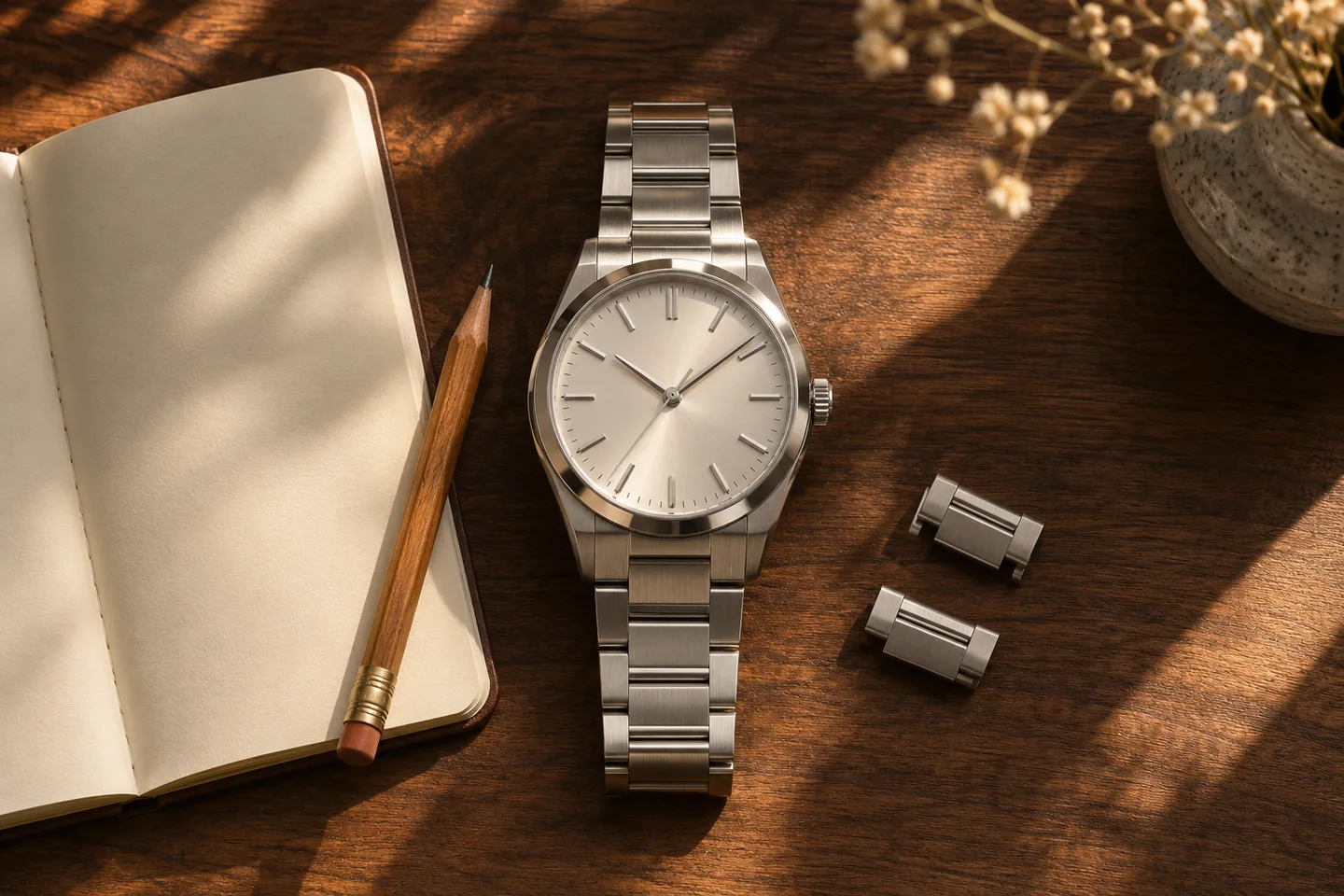
Compare condition, accessories and shipping origin as well. Box and papers matter when they help establish the history or are valued for that reference. On an integrated bracelet, the spare links you need may have a more immediate effect on cost than a pristine outer box.
Build a small, clean sample
Look for recent completed sales of the same reference in comparable condition. Record the date, condition, included accessories and price. Suppose five results are €270, €285, €290, €300 and €420. The median is €290. Before treating €420 as an opportunity, check whether it involved a different variant, a documented service or a faulty comparison. These are fictional figures for illustration.
Use active listings to see what is available today. To estimate what buyers agreed to pay, look for completed transactions. At auction, check whether the amount is the hammer price or includes a buyer’s premium. With only one or two comparable results, use a wider range and allow for the uncertainty in your offer.
Add up the cost of getting it onto your wrist
Imagine that the first watch costs €260, plus €15 shipping, €30 in links and €25 for inspection. It comes to €330. The second costs €310 plus €10 shipping, or €320 if it is ready to wear. You might also set aside a workshop allowance for the first, but a diagnosis is what turns that allowance into an expected expense. Include platform fees and any applicable import costs in the total.
If you are buying to resell, work backwards. Start with a conservative sale price and deduct inspection, preparation, fees, shipping you will cover, after-sales allowance and your target margin. Account for applicable taxes separately from commercial margin. A watch can be a good personal purchase and leave very little room for resale.
Set your limit before the conversation
Bring the price of comparable pieces, the likely cost of getting this one ready, and your delivered price ceiling to the negotiation. If the price exceeds that ceiling, identify what would justify raising it. A verifiable history or unusual condition might. Pressure to decide quickly adds little to the watch itself.
Work through three scenarios
Calculate the cost if the watch is ready to wear, if it needs the work you consider likely, and in a reasonable worst case. In a fictional example, you pay €260 plus €15 shipping. With a €25 inspection, the first total is €300. If €30 links are needed, it rises to €330. If a workshop confirms a further €110 repair, it reaches €440. The difference shows how much you are risking by relying on condition that has yet to be verified.
The third scenario helps you decide whether to proceed before a diagnosis. If the possible repair wipes out the margin or costs more than an already inspected example, you can make the offer conditional on inspection. Ask whether a workshop estimate includes diagnosis, parts, labour and final testing.
Keep a record of your assumptions
Save three comparable sales, the assumed condition and your expected selling window if the purchase is commercial. When a counteroffer arrives, ask which assumption has changed. If the only change is the seller’s urgency, the likely cost of the watch remains the same.
If buying to resell, check the margin at the price you would accept to move the stock. A watch that only makes money at the top of your sample is vulnerable to ordinary negotiation. The best purchase ceiling is the one that still makes sense when the sale goes as expected.
The next chapter covers how to keep the watch fit for the way you intend to wear it.
Back to Journal