You take the watch off on Friday evening. On Monday the hands are still. In an automatic, this can simply mean that the power reserve has run out. To understand what happened, look separately at how the watch receives energy, how long it stores it, and how steadily it keeps time.
From energy to rhythm
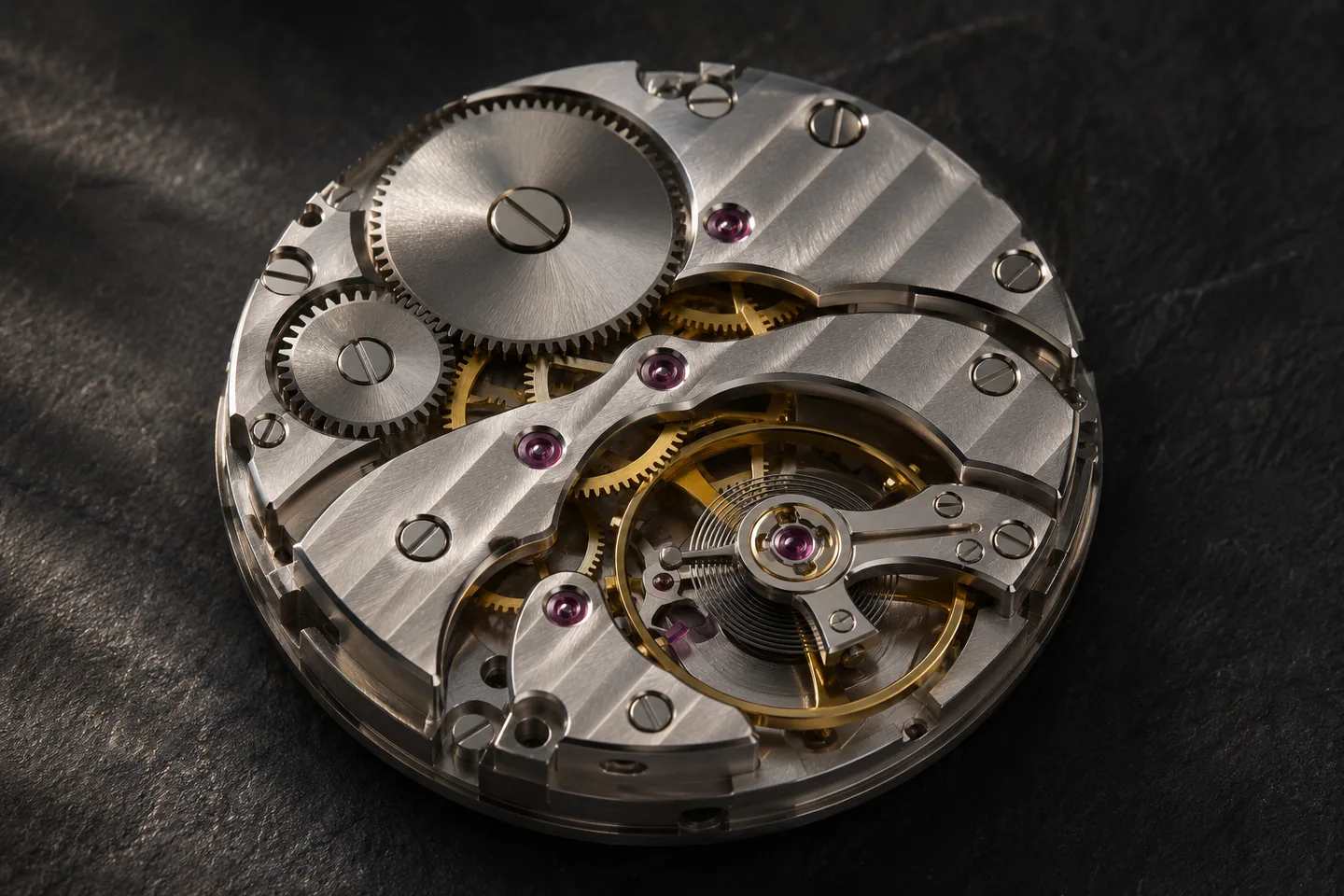
In a mechanical watch, the mainspring stores energy as it winds. The gear train transfers that energy and the escapement delivers impulses to the balance. The balance and hairspring oscillate and set the pace at which the train advances. Turning the crown can wind the spring. In an automatic, the moving rotor can do so as well.
In an analogue quartz watch, a circuit uses the oscillation of a crystal as its reference and drives a motor that advances the hands. That changes the experience of ownership. A healthy quartz watch makes sense if you want to pick it up after several weeks and head out with the right time. If you enjoy setting the hands and interacting with the crown, that ritual can be part of the pleasure of a mechanical watch.
What 41 or 80 hours mean
Seiko quotes approximately 41 hours for the 4R35 in the Presage SRPB41J1. Tissot quotes up to 80 hours for the PRX Powermatic 80 T137.407.11.041.00. Those figures are useful when rotating watches, provided you consider how much energy the spring had when you took the watch off. A few hours of quiet desk work may leave it with less charge than you expect.
If your automatic can be hand-wound, follow its calibre instructions when restarting it. To measure reserve, charge it according to the manual, note when you put it down, and record when it stops. Repeating the test helps distinguish an insufficient starting charge from a consistently short running time.
Measure the rate as you wear it
Synchronise with a time reference and record the difference at the same hour over several days, without resetting the watch. If it is 32 seconds fast after four days, it averaged eight seconds gained per day over that period. Keep the daily readings as well. Four similar results tell a different story from a sudden jump on the third day.
Resting position, state of wind and wearing habits can all influence the rate. A timegrapher helps a watchmaker observe rate, amplitude and beat error under controlled conditions. Ask for the measurement context, including position and state of wind. A photo of a single number tells you little about performance on the wrist.
The calendar has a schedule of its own
Read the manual before using a quick-set date. For the Seiko 4R35, for example, the manufacturer advises against quick-setting the date between 9 p.m. and 1 a.m. as shown by the hands. Other calibres have different windows. If the date changes at noon, first check whether the watch is set to the correct a.m. or p.m. cycle.
What a workshop reading can tell you
Rate estimates gain or loss under the test conditions. Amplitude describes how far the balance swings. Beat error describes the timing asymmetry between the two halves of its oscillation. Position, state of wind and instrument settings can affect the reading. For amplitude, the lift angle set on the instrument should match the calibre.
Ask whether the watch was measured in several positions, whether it was wound, and whether the test was repeated after an interval. The same watch may show different figures dial up and crown down. A repeatable method and someone familiar with the movement make the comparison more useful. If the rate changed suddenly, mention that before asking for a simple regulation.
An exercise for your first seven days
On the first day, synchronise the watch and note how it was wound. Over five days, check the deviation at the same hour and record whether you wore it all day or only briefly. On the sixth evening, set it down in a position you can repeat. To compare two resting positions, repeat the exercise in another week with a similar routine.
Compare days with similar conditions first. If the watch was on your wrist for ten hours on Tuesday and on a desk all Wednesday, record that difference before attributing the result to the calibre. Take the record to a watchmaker if the rate changes abruptly or the watch stops after being adequately wound.
These checks help you ask better questions of a seller. In the next chapter we open the listing and examine what its photographs and paperwork can actually establish.
See the Seiko 4R35 and Hamilton mechanical movement manuals and the official specifications for the Seiko SRPB41J1 and Tissot T137.407.11.041.00.
Back to Journal