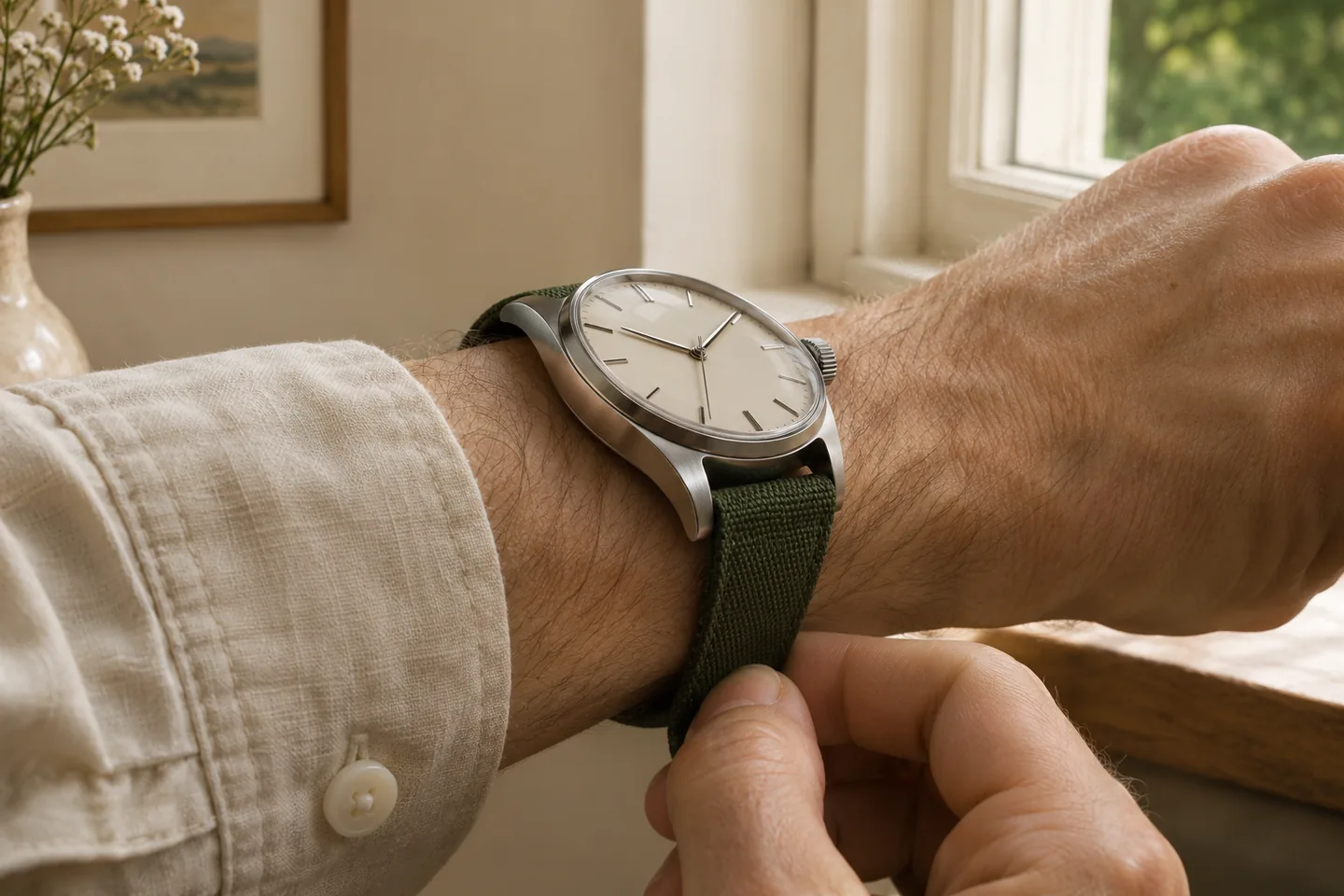
Some watches make a persuasive photograph and lose their appeal within ten minutes on the wrist. Others seem quiet in a display case and end up being worn more than anything else you own. The difference often appears when you stop looking straight at the dial and pay attention to how the watch moves with you.
Four measurements worth knowing
Diameter measures the case from side to side, usually excluding the crown. Lug-to-lug length tells you how much space it occupies along the wrist. Thickness gives you a sense of whether it will slip under a cuff. Lug width matters chiefly when choosing a strap. Each figure answers a different question.
The Hamilton Khaki Field Mechanical H69439931 is 38 mm across, 47 mm lug to lug and 9.5 mm thick. The diameter suggests a modest watch. The length explains why a side view is worth seeing. With a 40 mm Tissot PRX Powermatic 80, the integrated bracelet adds another variable. Notice where its first link begins to fall. A case may fit while the bracelet still leaves a gap on either side of the wrist.
Measure the surface that supports the case
Circumference helps size the bracelet. For the case, also measure across the visible top of your relaxed wrist. Two wrists of the same circumference can have very different shapes. Use that width as a starting point and look at the curve of the lugs. A downward curve can follow the wrist where a straighter lug might hover, even when the published length seems reasonable.
When buying remotely, ask for a head-on photograph, a profile at wrist level, and a mirror shot with the arm relaxed. A close-up can make the case look disproportionately large. A mirror photograph gives a better idea of how it looks to someone standing nearby.
Wear it for five minutes
Close the clasp, lower your arm and bend your wrist as if you were writing or driving. Does the crown press into your hand? Does the watch roll? Is the clasp centred? Try drawing your cuff over the case. If the bracelet must be tight enough to leave a mark before the watch sits comfortably, try another fit or size.
Finally, read the time at a glance in the shade. A handsome dial can lose contrast when its hands and background catch the light in the same way. On an everyday watch, that small inconvenience repeats itself.
The Maison rule
How the bracelet changes the fit
Before deciding that the case is too large, try centring the clasp underneath the wrist. On a link bracelet, changing how the links are distributed can move the case into a better position. If the clasp sits to one side, ask to try another distribution. Some clasps offer micro-adjustment and some bracelets have half-links. Check the clasp reference and adjustment system on the actual watch.
A metal bracelet that feels comfortable on a cool day can feel tight after a walk in summer. Try the watch after moving around. If you fall between settings, see whether the looser one lets the case roll. On an integrated design, ask for the usable bracelet length before buying remotely. A picture of the spare links alongside the watch helps establish what is included.
A test you can repeat
Note the model, lug-to-lug length, thickness, clasp type and the setting you used. Try reading the time in three different light conditions. Record where you felt pressure when bending your wrist and whether your cuff passed without snagging. Rate comfort and legibility on a scale of one to five. A millimetre on its own explains very little. The same test on two watches gives you something concrete to compare.
If you try two watches on different days, use the same cuff and make sure each bracelet is adjusted. That helps you tell whether the difference comes from the case, the fit or the conditions of the trial.
If two watches fit, favour the one you can picture wearing on an ordinary Tuesday. A watch that fits your routine has more chances to gather a history of its own. The next chapter moves from the wrist to what happens inside the case.
For the measurements, see the official specifications of the Hamilton Khaki Field Mechanical H69439931 and Tissot PRX Powermatic 80 T137.407.11.041.00.
Back to Journal